
Published: July 28, 2026 · Reading time: 6 minutes
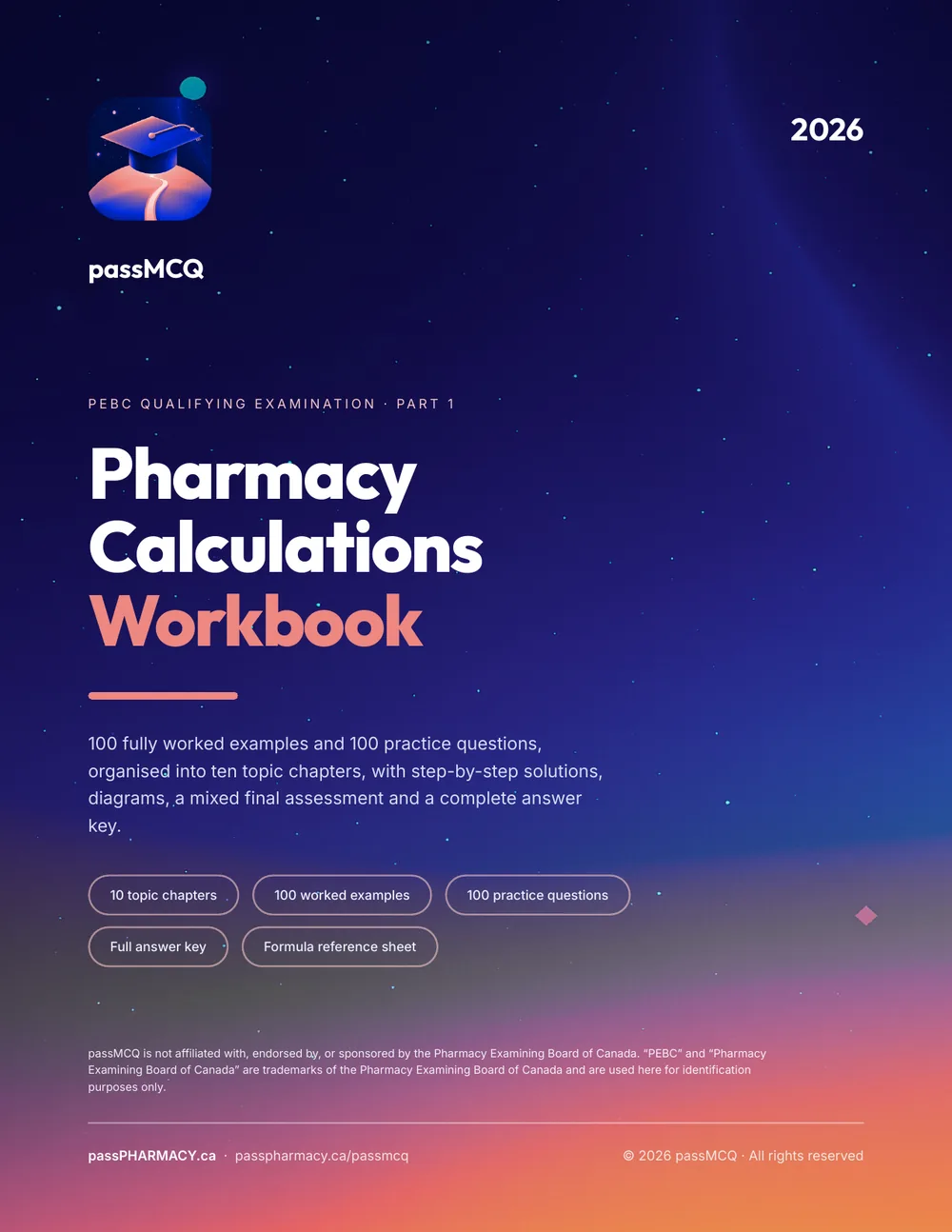
On a multiple-choice paper, a calculation question is unusual: there is no partial credit, no examiner interpreting your reasoning, and no room for a well-argued near-miss. You either arrive at the option in front of you or you don't. That makes calculations both the most unforgiving questions on Qualifying Examination Part 1 — and the most rewarding to prepare properly. Today we're releasing the passMCQ Pharmacy Calculations Workbook: a complete, exam-focused calculations course in a single electronic workbook.
Why Calculations Deserve Your Attention
Calculation items are scattered throughout Part 1 rather than sitting in one labelled block — inside therapeutics questions, dosing scenarios, infusion problems and clinical monitoring. Three things make them worth disproportionate preparation time.
First, calculations are method-based, not memory-based. Most of the paper rewards recall built over years. A calculation question rewards a procedure you can learn in an afternoon and own for life. There is no clinical judgement to second-guess: either the method is right and the arithmetic holds, or it doesn't. That makes calculations the single most controllable block of marks available to you.
Second, the same handful of skills reappear everywhere. Percentage strength turns up again in dilutions, in electrolyte problems, in parenteral nutrition and in infusion rates. Master the foundations early and the return compounds across the whole syllabus — which is exactly why this workbook builds outward from percentage strength rather than jumping between topics.
Third, MCQ distractors are built from predictable mistakes. The wrong options in a well-written calculation item are not random: they are the answers you get from a factor-of-ten slip, from rounding early, or from reading the ratio upside down. A candidate who has drilled the method recognises the shape of the question and moves on; a candidate who hasn't finds a plausible-looking wrong answer waiting for them.
Where Marks Are Actually Lost
The errors that cost candidates marks are remarkably consistent, and almost none of them are arithmetic:
- Units, not numbers. Grams read as milligrams, millilitres as litres, micrograms dropped by a factor of a thousand. Writing the units on every single line is the one habit that prevents most wrong answers.
- Picking the wrong percentage. % w/v, % w/w and % v/v describe different things. Solids in liquids, solids in solids, liquids in liquids — confusing them quietly invalidates everything downstream.
- Rounding too early. Rounding mid-calculation and carrying the error forward turns a correct method into a wrong answer that often matches a distractor exactly. Carry full precision; round once, at the end.
- Answering the wrong question. “How much drug is in this product?” and “how much product delivers this drug?” use the same equation read in opposite directions. Deciding which one is being asked is most of the work.
- Skipping the plausibility check. If an answer could not actually be dispensed or infused, it is wrong — and a five-second sanity check catches it before you commit to an option.
Every one of those failure modes is trainable. That is the premise the workbook is built on.
What's Inside the Workbook
- 158 pages across 10 topic chapters — percentage strength and concentration; dilution, concentration and alligation; dosage, quantities and days supply; intravenous rates and infusions; electrolytes (milliequivalents, millimoles and milliosmoles); parenteral and enteral nutrition; applied pharmacokinetics; compounding and product preparation; biostatistics and literature evaluation; patient-specific clinical calculations.
- 100 fully worked examples. Every step states what is being done before the arithmetic appears, so you follow the reasoning instead of memorising a result.
- 100 practice questions with ruled working space on the page — you work them like exam day, not in your head.
- A mixed 15-question final assessment. Deliberately unlabelled and timed, because working out which method a question wants is half of what is being tested.
- A complete answer key with full worked solutions — short answers first for quick marking, then the full method for anything you missed.
- A print-friendly formula reference sheet covering every formula in the book, on two pages.
- Exam tips and common traps flagged throughout, tied to the specific error each question type invites.
Also available in Canadian French. The workbook has been fully translated for francophone candidates — every chapter, example, solution and formula. Buy from the French version of this page to receive the French edition.
How to Buy Your Copy
The workbook is a one-time purchase of $49 CAD — no subscription needed, and buying it doesn't start one. It is an electronic edition (PDF), and each copy is licensed to one candidate, with that person's name printed on every page. Here is the whole process:
- Open our Subscription page and scroll to The Calculations Workbook card, just beneath the plans.
- Type the name you want printed on your licensed copy — use the name you'd want on a document that is yours.
- Press Buy the workbook. You'll be taken to Stripe's secure checkout, where you enter your email and choose a payment method.
- Have a promotion code? Enter it in the Add code field at checkout before paying.
- Complete the payment. Your licensed copy is prepared automatically and emailed to you in under a minute — check your spam folder if you don't see it right away.
Frequently Asked Questions
Is the Calculations Workbook a printed book?
No. It is an electronic edition (PDF) only. It opens on any phone, tablet or computer, and you can print it at home if you prefer to work on paper.
Do I need a passMCQ subscription to buy the workbook?
No. The workbook is a separate one-time purchase. You do not need an active subscription, and buying the workbook does not start one.
What does “licensed to your name” mean?
Each copy is prepared individually for its buyer, with that person's name printed on every page. The copy is for your own exam preparation and should not be shared or redistributed.
How quickly does the workbook arrive?
Your licensed copy is prepared and emailed automatically as soon as the payment completes, normally in under a minute. If it is not in your email shortly after, check your spam folder.
Is the workbook available in French?
Yes. A Canadian French edition is available. Buy from the French version of the passMCQ site and you will receive the French edition of the workbook.
Can I use a promo code?
Yes. There is a promotion code field on the secure Stripe checkout page — enter your code there before completing payment.
What if I don't receive my copy?
Check your spam folder first, then write to support.mcq@pass-mcq.ca with the email address you used at checkout, and we'll re-send your licensed copy.
Still Working Toward the Evaluating Exam?
There is a companion volume. The passEE Pharmacy Calculations Workbook is a 163-page edition built for the PEBC Pharmacist Evaluating Examination, in the same format with its own syllabus weighting and its own questions.
Questions, corrections or a topic you'd like to see expanded? Write to support.mcq@pass-mcq.ca — reader feedback shapes the next edition.